La versión en español de este Comunicado puede ser descargada en este enlace
SACRAMENTO, Calif. — The California Public Employees’ Retirement System (CalPERS), Covered California and the California Department of Health Care Services (DHCS) announced major improvements in care quality and health outcomes after two years of aligned, performance-based programs.
Together, these programs reach more than 45% of Californians (approximately 17.7 million people) and drive progress on key clinical measures, such as blood pressure control, diabetes management, colorectal cancer screenings and childhood vaccinations.
While each program operates differently, CalPERS, Covered California and DHCS are driving measurable improvements in care delivery statewide.
CalPERS
CalPERS is the largest purchaser of public employee health benefits in California, providing coverage to more than 1.5 million public employees, retirees, and their families. Through its Quality Alignment Measure Set (QAMS) program, CalPERS requires health plans that do not meet quality improvement targets to pay penalties that, by 2027, can range as high as 4% of total premiums.
With these incentives, for most measures, health plans did not pay a penalty because they surpassed the target of the 66th percentile of care delivered nationally in 2024. For the health plans that did incur a penalty, CalPERS collected $11.9 million, which will be used to help lower premiums for members.
“We’ve seen meaningful improvement from our health plans in health care quality and access in our first year," said CalPERS Chief Clinical Director Dr. Julia Logan. “Improvements on these measures translate into better care and saved lives for our members.”
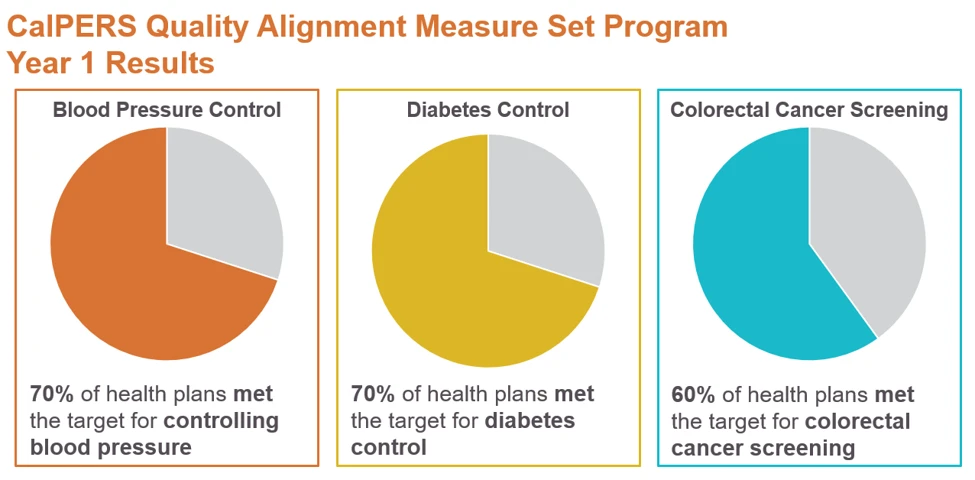
During the program’s first year, seven out of 10 CalPERS health plans, covering 91% of members, reported better outcomes for patients by improving blood pressure and diabetes control. Six out of 10 plans improved rates of members receiving colorectal cancer screenings.
The importance of these quality improvement efforts is underscored by research showing that even modest gains in a few key quality measures can have a profound impact on health outcomes. A 2024 National Quality Forum study projected that improving blood pressure control and colorectal cancer screening could prevent avoidable deaths and improve population health at scale. Through CalPERS’ QAMS program, those same measures are being used to help drive better care for members.
Covered California
Covered California’s Quality Transformation Initiative (QTI), led by Chief Medical Officer Dr. Monica Soni, links health plan payments to performance and directs plans that fall short to invest up to 4% of premium dollars in statewide population health programs.
“By focusing on a few key clinical measurements, we’re able to potentially save thousands of lives across the state,” said Dr. Soni. “In the second year of our accountability program, we saw every plan offered through Covered California meet the benchmark for diabetes control. This means that no matter what health plan you get through Covered California, you are sure to get high-quality diabetes care.”
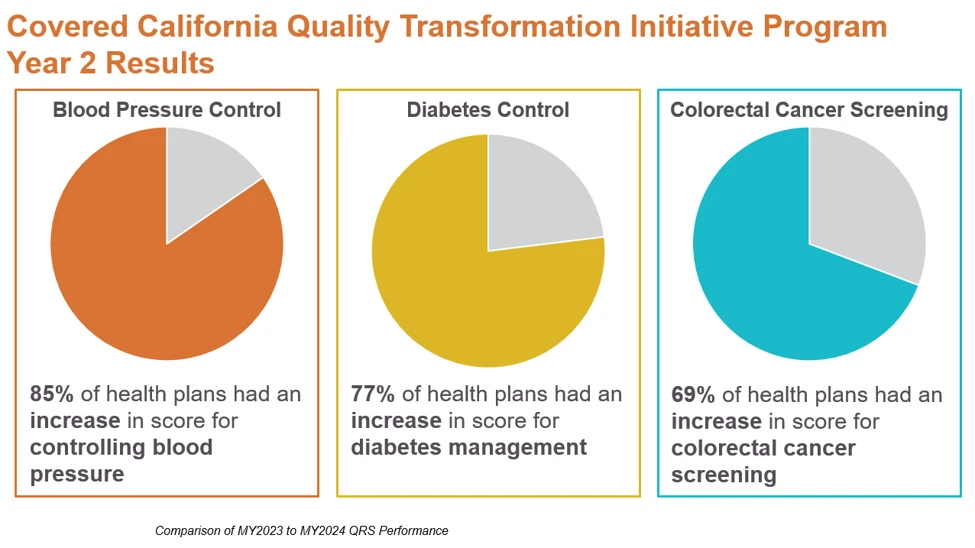
In its second year, 11 of 13 health plans improved their blood pressure control, 10 improved diabetes management and nine improved colorectal cancer screening rates.
Covered California directed approximately $19.6 million in 2026 toward initiatives that expanded access to groceries for enrollees, increased well-child visits and childhood vaccination rates, and supported independent primary care practices across the state.
Read the full Covered California QTI report.
Department of Health Care Services (DHCS)
DHCS, which covers about 14 million Medi-Cal members, uses its Quality Withhold and Incentive (QWI) program to set care quality standards across Medi-Cal health plans. Launched in 2024, the program tracks plan performance across a range of measures, including chronic disease management, supporting new parents and ensuring timely early childhood checkups.
All measures in the QWI program intentionally overlap with the Medi-Cal Managed Care Accountability Set, which holds Medi-Cal health plans accountable to minimum performance expectations subject to monetary sanctions. Further, most of the QWI measures overlap with the Auto Assignment Inventive Program, which provides additional incentives for Medi-Cal health plans to perform well on quality measures. Collectively, these programs work in alignment to ensure Medi-Cal members receive equitable, high-quality care, regardless of where they live or which plan covers them.
“We feel a deep responsibility to protect health access for everyone in California and increase the availability of quality care for those historically underserved,” said DHCS Chief Quality and Medical Officer Dr. Chris Esguerra. “In just two years, we have seen substantial improvements in health care delivery and quality.”
In the program’s first year, performance improved on 11 of the 13 QWI measures across all plans, demonstrating improvements in care delivery across services. Some of the strongest gains included blood pressure control, postpartum care, and well-child visits in the first 30 months, which are vital for preventing future health issues and supporting child development.
In 2025 and 2026, DHCS withheld approximately $600 million that health plans can earn back by meeting targeted improvements or benchmarks for quality measures. DHCS is currently calculating 2025 performance and expects to release that information in 2027.

Read the full DHCS report on first year performance.
Through this aligned statewide effort, CalPERS, Covered California and DHCS are driving continued improvement in health plan performance, strengthening managed care accountability and enhancing care delivery for millions of Californians.
About CalPERS
With more than 1.5 million members, CalPERS is the largest purchaser of public employee health benefits in California and the second largest public purchaser in the nation after the federal government. In 2025, CalPERS spent over $13.9 billion to purchase health benefits for active and retired members and their families on behalf of the State of California (including the California State University system) and nearly 1,200 public agencies and schools.
About Covered California
Covered California is the state’s health insurance marketplace, where Californians can find affordable, high-quality insurance from top insurance companies. Individuals who qualify can get financial assistance on a sliding scale to reduce premium costs. Consumers can then compare health insurance plans and choose the plan that works best for their health needs and budget. Depending on their income, some consumers may qualify for the Medi-Cal program.
Covered California is an independent part of the state government charged with making the health insurance marketplace work for California consumers. It is overseen by a five-member board appointed by the governor and the Legislature. For more information about Covered California, please visit CoveredCA Homepage.
About Department of Health Care Services
DHCS administers Medi-Cal, the state’s Medicaid program, and leads efforts to improve the quality, equity, and coordination of care for more than 14 million Californians. Through programs, such as Quality and Population Health Management and the Population Health Management Division, DHCS advances data-driven, evidence-based strategies, whole-person care, and population health initiatives that strengthen managed care accountability, improve health outcomes, and ensure Medi-Cal members receive accessible, high-quality services tailored to their needs. For more information, please visit the DHCS website.